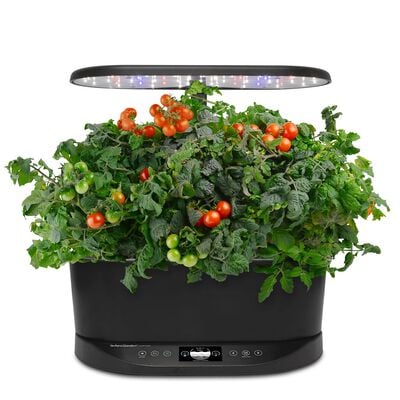
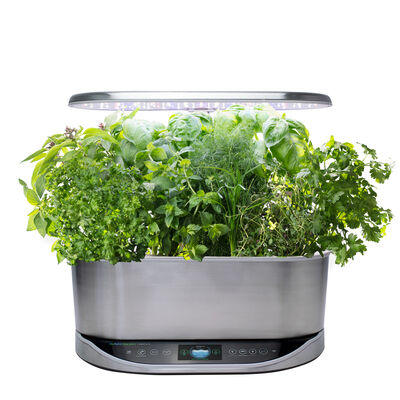
General Questions About the AeroGarden


Q: What is Aeroponics?
A: Aeroponics is a dirt-free growing method where plant roots are suspended in air within a 100% humidity, highly-oxygenated growing chamber. Because the roots are bathed with ideal levels of nutrients, water and oxygen, plants grow significantly faster, are healthier and have a higher nutrient content than plants grown in soil.

Q: How big is the AeroGarden?
A: There are currently nine different models and sizes of AeroGarden®. The chart below shows their dimensions, including the height of the lights at both their lowest and highest settings.


AeroGarden Width Depth Height (Min) Height (Max)
Classic 18 1/2 10 1/2 15 1/5 22
Deluxe 18 1/2 10 1/2 15 1/2 34
Pro 100 18 10 1/2 16 1/2 22
Pro 200 18 10 1/2 16 1/2 34
3 9 1/2 11 14 20
Space•Saver 6 14 11 15.5 21
6 18 1/2 10 1/2  15 1/2  21
6 Elite 18 1/2 10 1/2  15 1/2  21
6 Elite + 18 1/2 10 1/2  15 1/2  34


Q: What comes with the AeroGarden?

A: The AeroGarden comes with everything you need for a complete season of growth, including:


Built-in plant lighting system

  • Full-daylight spectrum, energy efficient grow lights allow you to grow anywhere. No natural sunlight is needed.


Aeroponic optimizing chamber

  • Creates a near-perfect rainforest growing environment


Computerized “smart” garden technology

  • Built-in microprocessor automatically controls the exact amount of light, nutrients and water needed for the specific plant type you are growing
  • Built-in lights timer turns lights on and off automatically
  • Built-in reminder system automatically alerts you to add water and nutrients when needed


Free Gourmet Herb Seed Kit with each AeroGarden, which includes:

  • Pre-seeded Bio-Dome™ Seed Pods enclosed in their own mini-greenhouse for ultra-fast germination
  • Time-release nutrient tablets, which provide perfect plant nutrition with all necessary macro- and micro-nutrients for optimal plant health
  • Full-color Tending and Harvesting Guide, which walks you through everything you need to know to grow and harvest your plants, as well as providing tips and recipes for enjoying your harvests


Q: How long will my plants live, and when can I begin harvesting?

That depends on which Seed Kit you are growing. The chart below compares different Seed Kits, with time-to-first-harvest (or bloom), lifespan of the Seed Kit, and length of harvest (or bloom time) for the crop you are growing.


Seed Kit

Time to Harvest

or Bloom

Lifespan

Continuous Harvests

or Blooms for:

Salad Greens 3-4 weeks Up to 5 months 3-4 months
Tomatoes 10-16 weeks Up to 7 months 4 months
Peppers 10-16 weeks Up to 7 months 4 months
Herbs 5-6 weeks Up to 5 months 3-4 months
Basil 3-4 weeks Up to 5 months 4 months
Flowers 5-10 weeks Up to 4 months Blooms up to 3 months
Mini Roses 1 week Up to 7 months Blooms up to 7 months


Q: How much time do I have to spend taking care of my AeroGarden?

A: Although all our Seed Kits are easy to care for, some require just a bit more interaction than others when it comes to tending and harvesting. See the chart below to decide which Seed Kit will be right for you.


Seed Kit Approximate Time Required
Salad Greens 1-2 minutes a week
Herbs and Basil 2-5 minutes a week
Flowers 2-5 minutes a week
Cherry Tomatoes 5-7 minutes a week
Chili Peppers 5-7 minutes a week
Mini Roses 5-7 minutes a week


Q: How long can the AeroGarden be left unattended? What if I travel a lot?

A: For the first 2-3 weeks after the AeroGarden is first planted, it is virtually care-free because the plants are small and use very little water, though they will need to have the Bio-Domes removed as the seedlings grow. At the other end of the spectrum, a fully-mature, productive garden may need to have water added every 2 or 3 days. But one of the beauties of the AeroGarden is that it is small enough to move, so if you travel and need to be away for some time, your AeroGarden can be left with a friend or neighbor for the minimal amount of care it will require in your absence.


Q: Are the nutrient tablets organic?

A: For produce to qualify as organically-grown, the fertilizers used must be derived from decomposed plant or animal material. This works well in soil, where microbes and insects convert this decaying plant and animal material into a form that is readily available to the plants (a process called “mineralization”). In an aeroponic environment, however, there is nothing to perform this conversion, leaving a smelly mess that the plants cannot absorb. To avoid this problem, our nutrient tablets are made instead from mineral salts that provide all the macro- and micronutrients needed by plants in a form that is immediately absorbable.


This complete plant nutrition assures that AeroGrown produce is extremely high in nutritional value. Recent studies have shown that produce grown in the AeroGarden is actually more nutritious than store-bought organically-grown produce. Click here for more information and references to these studies. For results of Vitamin C studies, click here.

 
Q: Can I mix my Seed Kits?

A: Mixing seed pods from one Seed Kit with those of another is generally not recommended.


Different plants have different light and nutrient requirements. Our Seed Kits have been carefully researched and exhaustively tested to determine the optimal light and nutrient requirements for each plant chosen. These plants have been combined within each Seed Kit to be compatible with one another. They are also chosen for compatible growth rate and size. For these reasons, mixing between Seed Kits generally does not work well, although there is some leeway. You can generally combine herbs with herbs, greens with greens, and flowering/fruiting crops with other flowering/fruiting crops (such as tomatoes with peppers).


Some people get around this issue by having multiple AeroGardens, so that they can have herbs, tomatoes and greens all growing at the same time, but in different gardens.


Q: Can I order a custom Seed Kit made up of just the plants I want?

A: In a way, yes - you can order a Master Gardener Kit, which allows you to grow your own seeds in the AeroGarden. The Master Gardener Kit allows you to experiment with an unlimited variety of herb, flower, or vegetable seed (purchased  from your local nursery or garden center), or grow just your favorites. We received many requests for customized Seed Kits, and the Master Gardener Kit is our answer!

Because of differing nutrient and light requirements, and also size compatibility, remember that not everything can be grown together in the AeroGarden. For more detailed instructions, see the Master Gardener Kit Guide, available by clicking here.

  
Q: How much will the AeroGarden raise my electric bill?

A:
The AeroGarden system has been designed for maximum efficiency. The entire system uses about the same energy as a single 60-watt light bulb, though this varies a little between models. Use the chart below to see how much energy your AeroGarden uses, and how much it will cost to run at an average US utility rate of 11 cents per kw/hour, (including taxes).


AeroGarden Model

Wattage Used During On Hours

Cost to Run Per Month at 11¢ Per kw/hour

Classic and Pro 100

42     (.042 kw)

$2.43  per month

Deluxe and Pro 200

62     (.062 kw)

$3.59  per month

3 and Mini

18     (.018 kw)

$1.04  per month

6, 6 Elite, 6 Elite +,

and Space•Saver 6

42     (.042 kw)

$2.43  per month


The formula used was:

  • the number of hours each day that your AeroGarden is on (to see a chart of the Timing of the Lights and Pump click here), multiplied by
  • the wattage figure given above for your model AeroGarden (divided by 1000 to convert it to kilowatts, as charged by the electric company), multiplied by
  • 31 days in a month, multiplied by
  • the cost per kilowatt hour ($.11 kw/hour)

For example, in a cubicle in one of our offices at AeroGrow we are growing Gourmet Herbs (on 17 hours a day) in an AeroGarden 6 (which uses 42 watts, or .0042 kilowatts, of power). This is on for 31 days a month, at an average utility rate of approximately $0.11 per kilowatt hour for electricity.


hours    X       kilowatts         X     days        X      utility rate          =  electrical cost per month

(17)       X       (.042)              X      31           X      .11                      =  $2.43 per month


To figure your own cost exactly, use the formula above but substitute the wattage of your model AeroGarden and the kilowatt/hour rate charged by your local utility company.


Q: What kind of light bulbs does it use?
A: The AeroGarden uses specially-engineered compact fluorescent bulbs that exactly match the spectrum and intensity of light needed for robust, healthy plant growth. At the end of their life, they can be recycled at any Home Depot store.


Q: Do you ship internationally?
A: While we do not ship internationally from the US, the AeroGarden is now available from the following distributors.


Q: Is produce grown in the AeroGarden organic?
To be considered organically-grown, food must have been produced without the use of pesticides, herbicides or chemical fertilizers. Since the AeroGarden is an indoor appliance, pests and weeds are generally not a problem, so pesticides and herbicides are not needed. In rare cases, bugs such as aphids may enter the home on clothing or produce, and in such cases it is up to the consumer’s discretion whether to use natural or synthetic pest control measures.


For produce to qualify as organically-grown, the fertilizers used must be derived from decomposed plant or animal material. This works well in soil, where microbes and insects convert this decaying plant and animal material into a form that is readily available to the plants (a process called “mineralization”). In an aeroponic environment, however, there is nothing to perform this conversion, leaving a smelly mess that the plants cannot absorb. To avoid this problem, our nutrient tablets are made from mineral salts that provide all the macro- and micronutrients that are needed for healthy, robust plant growth, in a form that is readily usable by the plants.


In terms of healthfulness and nutritional value, fresh produce grown in the AeroGarden is actually more nutritious than store-bought organically-grown produce. For references to studies, please click here. For results of Vitamin C studies, click here.


Another health benefit of AeroGrown produce is that it is not subject to the E. coli and salmonella contamination that sometimes plagues field-grown produce. For references, please click here.


Q: Do you use GMO seeds?
AeroGrow does not use genetically-modified seeds, and is committed to never doing so. AeroGrow participates in the "Safe Seed Initiative" which is run by the Council for Responsible Genetics. We have signed the "Safe Seed Pledge" in which we have pledged to never knowingly buy or sell genetically engineered seeds or plants. Many of our seed suppliers have also signed this pledge.


Q: Does the AeroGarden help me reduce my carbon footprint?
Growing food aeroponically at home in the energy-efficient AeroGarden is a great way to reduce your “food miles,” or the distance your food must travel between the field and your plate, thus reducing your carbon footprint. Growing food at home in your AeroGarden –

  • Produces only about half the carbon of a comparable amount of food grown and shipped from field to home1
  • Eliminates food miles (on average, produce in the US has been shipped 1500 miles)
  • Encourages preparing and eating meals at home

In addition to these Earth-friendly benefits, growing food at home in the AeroGarden –

  • Increases oxygen in the home
  • Results in consuming more fruits and vegetables

AeroGrow is committed to continuously improving AeroGarden products to increase efficiency and reduce waste. For more information on AeroGrow and AeroGarden sustainability, please continue reading below.


1 Comparing CO2 emitted by an average U.S. power plant with an average mix of fuels to generate the electricity required to power a 7-Pod AeroGarden to grow a Salad Greens Seed Kit, to the CO2 emitted transporting an equivalent number of bags of lettuce from field to store to home.


Q: Is AeroGrow as a company committed to sustainability?
As a company, AeroGrow has always valued sustainable practices. We began in what is arguably one of the greenest cities in America - Boulder, Colorado - and have chosen to stay here as we grow even though some expenses are higher, because, for example, we have the opportunity as a business electricity user to contribute to the City of Boulder’s climate protection programs.


  • In 2006 we needed to relocate in order to expand. In that process, we selected a building in Boulder which –
  • Provides energy efficient measures such as motion sensors on all light switches and solar-gain reducing blinds
  • Is located on a bus line
  • Provides secure, sheltered bike storage, shower, and locker facilities
  • In addition, we –
  • equip workstations with Energy Star compliant monitors and use sleep power management modes to reduce power consumed by our computers.
  • recycle all AeroGardens used in research and development.
  • provide containers for paper waste recycling, container recycling and composting (30-50 gals/wk).
  • compost all plant material from our nursery and lab
  • We believe sustainability also includes employee wellness:
  • We encourage employees to bring their lunch through a large, comfortable lunch room, multiple refrigerators, microwaves and other kitchen appliances.
  • We provide washable silverware, plates, and cups, and we do the dishes.
  • We provide filtered water and a daily fruit bowl along with coffee and tea.
  • We provide weekly on-site chair massage and yoga classes.


Q: Is the AeroGarden a “green” appliance?
As an appliance, the AeroGarden is --

  • Designed for re-use
  • Designed for energy efficiency (entire appliance uses less electricity than a 60 watt light bulb2)
  • Made entirely from recyclable components (except the Grow Bulbs)

Many parts of AeroGarden packaging are recyclable:

  • Cardboard shipping boxes are recyclable at most local facilities
  • Paperboard seed kit boxes and formed paperboard packing materials are recyclable as paperboard (the same as cereal boxes and egg cartons)

Product changes have been implemented since product introduction:

  • Styrofoam packing replaced by formed-paperboard packing (now recyclable)
  • Growing medium changed to increase biodegradability (now above 90%)
  • Bulk packaging implemented for retailers, reducing overwrap packaging
  • Introduction of Master Gardener Kit and Garden Starter Tray, which have reusable Grow Domes, Baskets or Tray, and replaceable, 90% biodegradeable, growing media
  • Bio-Domes are recyclable PET plastic (#!)
  • Grow Baskets are recyclable ABS plastic

Additional product changes are being implemented in 2008:

  • Increased photon flux to plants with our newly-designed bulbs, without any increase in power usage
  • Reduced plastic in new AeroGarden 6 versus 7-pod platforms
  • Reduced garden plastic per plant for Space•Saver 6 versus AeroGarden 6
  • Reused ballast in Deluxe, Pro200, AeroGarden 6 Elite+
  • Reduced ink on all new packaging
  • Reduced ink in product literature

2 For all AeroGardens with one or two bulbs; AeroGardens with three bulbs use fewer than 65 watts.


Q: Are your seeds organic?
AeroGrow Seeds are not certified organic at this time, for two reasons: 1) We have scoured the earth for seeds of the best and tastiest small-variety vegetables, herbs and flowers that are available, and we have chosen to give preference to the best varieties rather than limit our choices to only those seeds that are commercially available as organically-grown; and 2) because of the tiny size of a seed relative to the plant that grows from it, and because the seed itself is not consumed. Please note, however, that we never use genetically-modified seeds.


Q: Is your fertilizer organic?
For produce to qualify as “USDA Certified Organic,” the fertilizers used must be derived from decomposed plant or animal material. This works well in soil, where microbes and insects convert this decaying plant and animal material into a form that is readily available to the plants (a process called “mineralization”). In an aeroponic environment, however, there is nothing to perform this conversion, leaving a smelly mess that the plants cannot absorb. Our nutrient tablets are made instead from mineral salts that provide all the macro- and micronutrients needed for robust, healthy plant growth in a form that is readily usable by the plants.


This complete plant nutrition assures that AeroGrown produce is extremely high in nutritional value. Recent studies have shown that produce grown in the AeroGarden is actually more nutritious than store-bought organically-grown produce.


Q: How nutritious is AeroGarden produce compared to organic produce from the store?
There are actually more vitamins, antioxidants and phytonutrients in AeroGrown produce than in most “certified organic” produce purchased from the supermarket: (References to studies cited below may be found here.)


For example, AeroGarden Salad Greens have been shown to contain 55% more Vitamin C than Earthbound Farms Organic Mixed Baby Greens from Whole Foods and 200% more vitamin C than a clamshell-packaged head of Organic Butter Lettuce from Whole Foods.


Hundreds of studies have shown that many vitamins, antioxidants, and other phytonutrients degrade during post-harvest transportation and storage (average time 5-14 days) before reaching the consumer.


Supermarket produce is often picked before ripe - before vitamins, antioxidants, and phytonutrients reach maximum levels.


In addition, AeroGrown produce is as “local” as you can possibly get! Studies show that children and adults eat more veggies when homegrown, such as in the AeroGarden. For more information, click here.


There is no risk of food-borne illness via bacterial contamination from commercial packaging, handling, or soil organisms (e.g., bacteria such as E. coli) with produce grown in the AeroGarden. (For references, click here.) Immune compromised patients, such as those undergoing chemotherapy, are currently being told not to eat raw, organic produce, such as salads, due to the risk of infection. With the AeroGarden, salads, fresh herbs, cherry tomatoes, and other vegetables can now be part of their diet again.


No ripening chemicals, such as ethylene (e.g., for ripening tomatoes) or modified atmosphere packaging (e.g., bagged lettuce), are used.


AeroGrown produce acquires no extra chemicals during transport and storage (e.g., truck and industrial refrigerator exhaust).


Last Updated ( Wednesday, 03 March 2010 04:25 )